
I think many who know Micah Seavers, his wife Kim, his mom Belinda, their families, or their restaurant, Southern Red’s BBQ in south Graves County, would probably at some point have turned to an age-old phrase to describe them:
They are the kinds of people that would give you the shirts off their backs.
It’s a common phrase used to signal that someone is willing to help others when they need it most. It’s most often metaphorical.
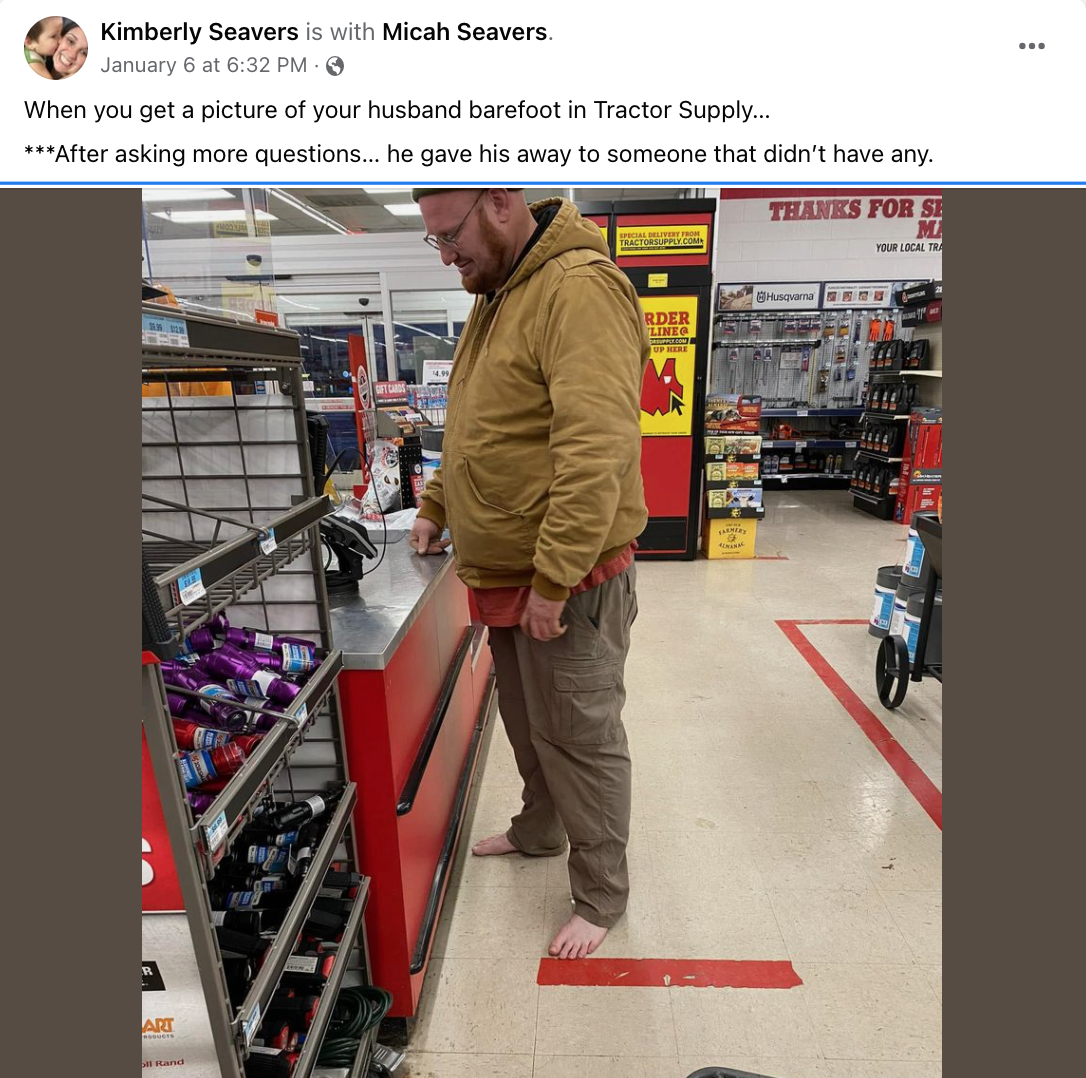
On January 7, when Kim posted a photo on Facebook of Micah standing at the cash register of the local Tractor Supply in Mayfield, clad in a sock hat, Carhartt coat, and work pants, wearing no socks or shoes, most could read between the lines of how he’d ended up that way.
Later, Kim did update the post to confirm everyone’s suspicions: Micah had indeed given his boots to someone who had none of his own.
When I talked to Micah about the instance, he had his normal hint of “aw shucks” attitude about the exchange.
“There’s this sweetest, older man, and he doesn’t have anything,” Micah said. “He likes to go outside, but he didn’t have any boots, and his feet were getting wet when he did.”
“He’s older, and he doesn’t need that. The manager of his apartment asked if I could find a pair of good boots for him.”
“We’d just upgraded his heater, and we’d taken him a meal, and I knew he was going to be out and about. I knew that he needed boots now, not tomorrow or a week from now.”
“I happen to wear a size 12, so I just reached down and slipped my boots off. I’d only worn them a few times. I just handed them to her. I don’t know if she knew exactly how to react to that. I just took my socks off and walked outside.”
It’s integral to remember that “outside” had somewhere around four inches of snow on the ground at the time, which is why the recipient needed the boots in the first place.
Giving the shirt off your back (again, mostly metaphorical) isn’t something that’s likely to be asked of a person day in and day out for a month. But, if you were Micah, Kim, Belinda, their family, and their community, it was something that was happening every single day. In the aftermath of an EF4 tornado that had devastated their town, they were working together to pick up the pieces, sort the rubble and take care of their own.
For Micah and Kim, it started about 10 minutes after the tornado had swept through their area on its path to Mayfield.
Micah, Kim, their messages to the community on Facebook, their friends, and their family combined to tell us how they made it from the night of impact through the first month, stopping along the way to help more than a few neighbors in need.
December 10, 2021, at 10:00 p.m. (15 minutes after the tornado had passed his home, sparing it by just a few miles)
“As soon as we knew everyone at the house was safe and we were good to go, we left,” Micah remembered. “A friend came, and we started making our way to Mayfield to see what we could do.”
Kim recalled, “We’d gotten a call from our nephew who is a fireman in Mayfield. His wife called and said the guys that were there on shift were trapped. Instantly, Micah and Dennis just left to go see what they could do to help.
Micah and Dennis cleared trees away from roadways from his home toward Mayfield so emergency vehicles could move safely through. They pulled a fire truck out of a ditch, Micah said, “so they could get back to doing fireman stuff.”
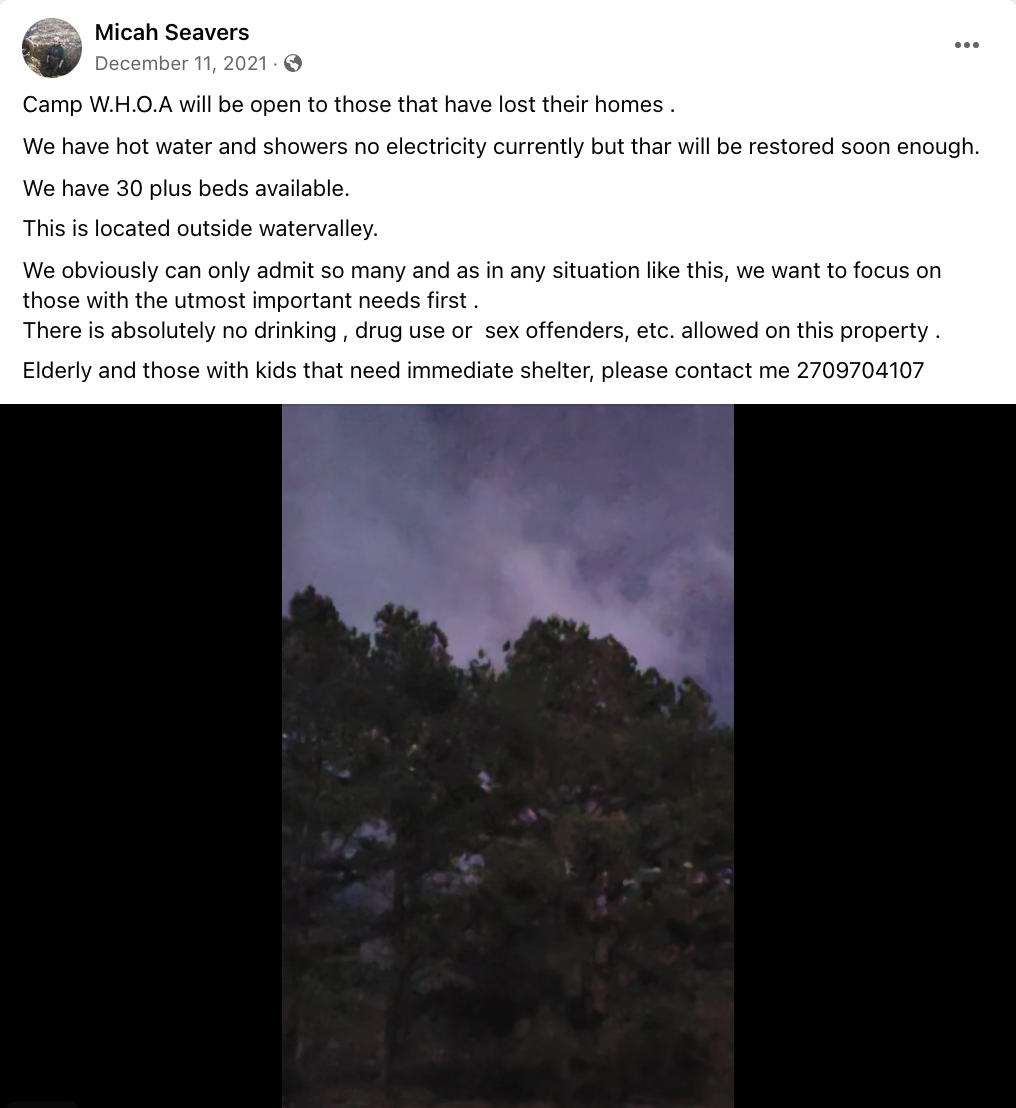
Sometime after midnight, Micah made his first Facebook post. It’s the first of too many to count after the tornado. In the post, lightning flashed through trees in a video, and Micah said his nonprofit campground Camp W.H.O.A would be open to those who had lost their homes.
When Micah and Dennis reached Mayfield, he posted on Facebook again. This time — a photo of Dennis from the passenger seat of the truck where it’s dark outside the windows. No one had seen the full extent of the devastation yet. Dennis is on the phone in the picture, his eyes wide as he looks out of the windshield in front of him.
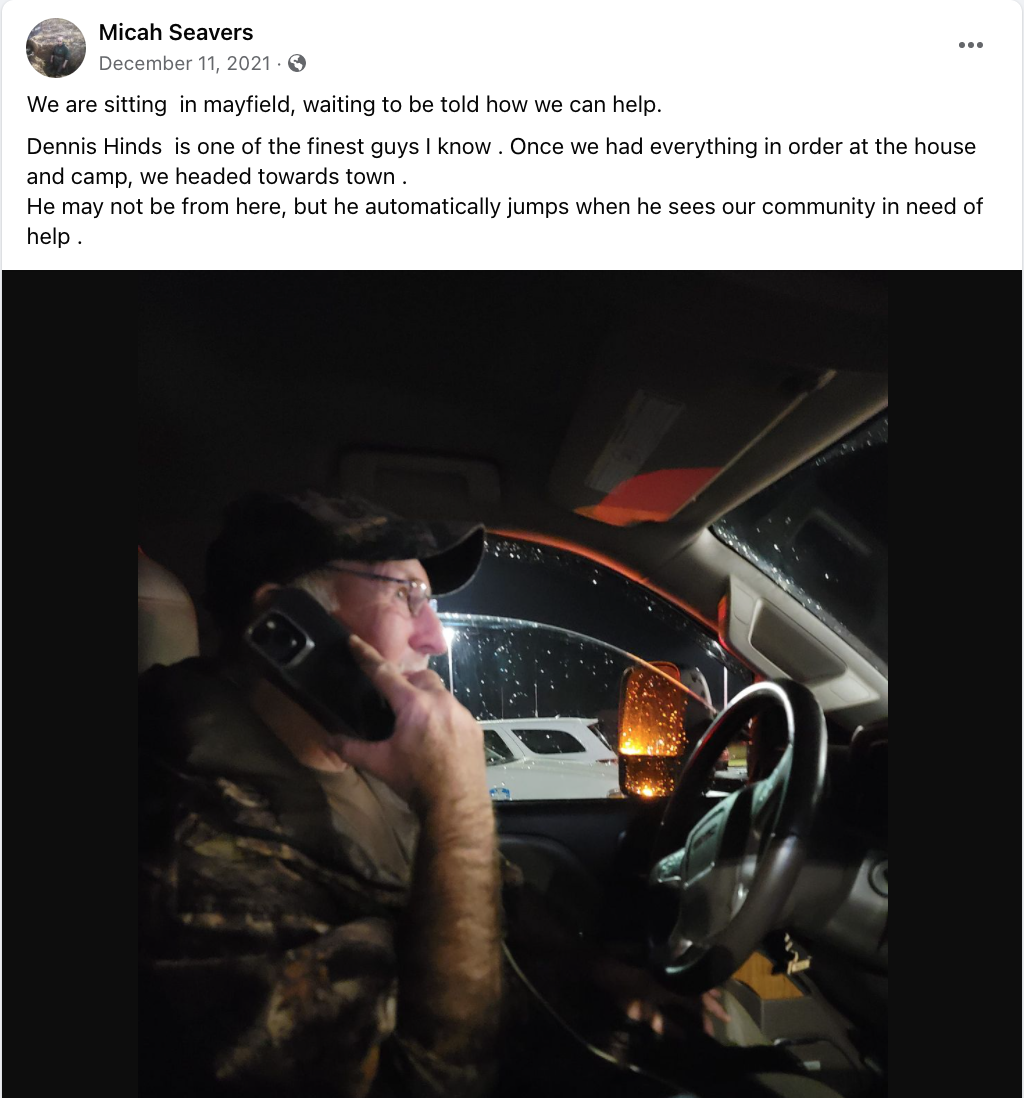
With the picture, Micah said: We are sitting in Mayfield, waiting to be told how we can help.
Volunteers were flooding into the Mayfield Consumer Products candle factory at this point in the night, joining the frantic efforts to pull survivors from the facility that took a direct hit. It would be the site of the town’s highest number of casualties and injuries from the tornado.
December 11, 2021
Micah and Dennis had worked all night, but moments later, they were back with new orders and a new mission. As the owners of Southern Red’s BBQ, Micah knew they could feed those volunteers — make sure they stayed strong during the search that would go on for days. Micah, Kim, Belinda, and their crews, family members, and volunteers prepared meals for 450 volunteers that morning.
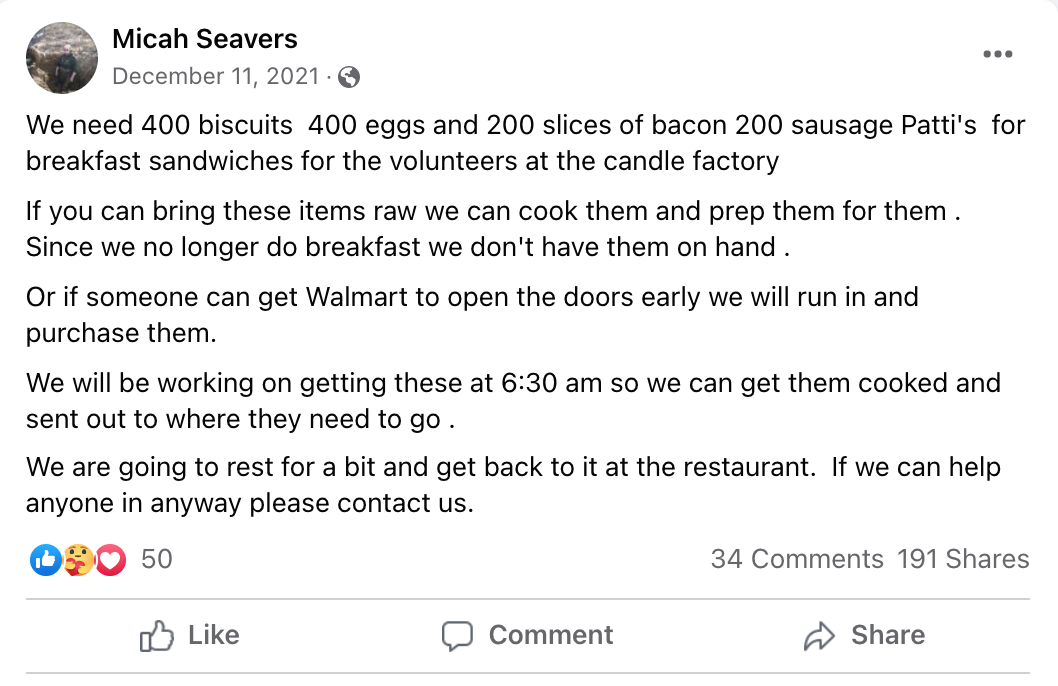
After those meals were delivered, his Facebook post ended with: If we can help anyone in any way, please contact us.
Later in the day, he sent out another SOS. We will be cooking anything brought to us for families in need and volunteers.
He asked for donations of biscuits to start the next morning. He expressed his gratitude for those who have gotten them through day one.
He said: Thank you so much for those that have helped make it possible to feed so many.
At the end of day one, Micah could have had no idea what the next 30 would look like for them.
December 12
Micah and Kim launched a GoFundMe account to raise money for local families who lost everything in the tornado. They used the account to pay rent for a local law enforcement officer and single dad who lost everything. They provided necessities for the families they were housing in their campground.

December 13
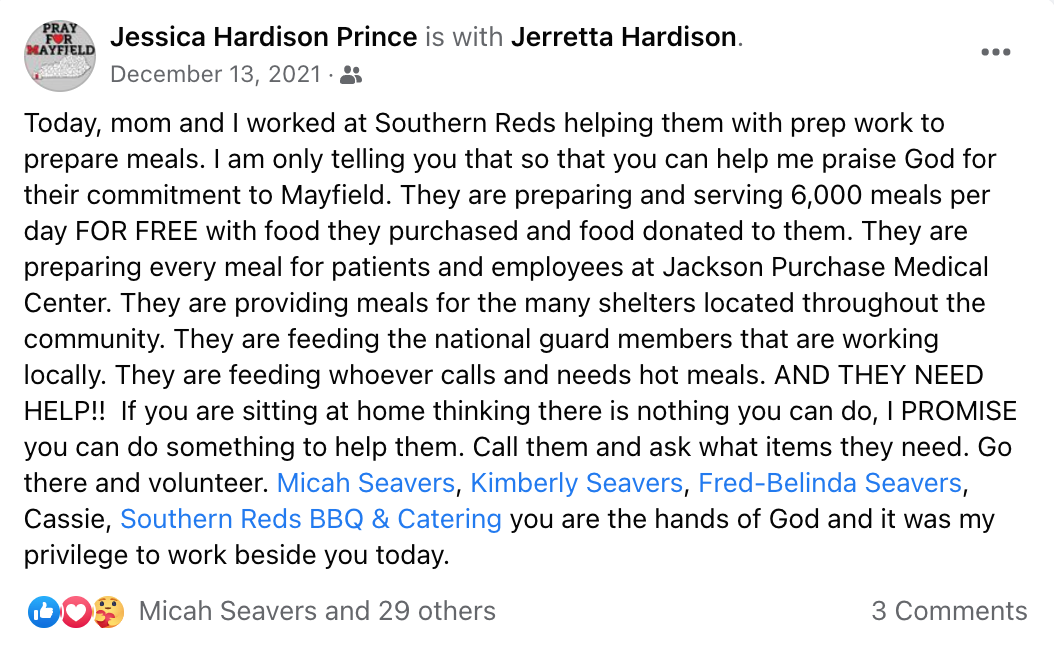
Jessica Prince and her mom Jeretta Harrison worked with Kim, Micah, and Belinda at the restaurant. On Facebook, Jessica said: Help me praise God for their commitment to Mayfield.
December 14
Micah and Kim helped organize a birthday party for a four-year-old girl who was housed at their campground after the tornado destroyed her home. Her birthday was Friday, the night the tornado hit. Her party had been scheduled for Saturday.
On Facebook, her mom said that she was so grateful for the kindness. She said: It was the best birthday ever!
The same day, Kim took the opportunity to thank everyone who had helped them.
There’s no way we could be feeding as many as we are without you!!!
December 17
It was seven days after the tornado had struck, and, in the first week, Micah, Kim, Belinda, along with volunteers, had served more than 60,000 meals. They fed those who were displaced. They fed volunteers who were stacking limbs and pulling debris from homes. They fed those who were still in their homes without power, heat, and water.
December 18
Working with several others who were delivering meals, Micah and Kim identified a major need for the people in Mayfield and Graves County.
Jaime Prince and her church, High Point Baptist Church, had been serving hot meals in the first week, using an ATV to reach as many homes as possible.
“We found people who had no idea that there were meals available for them,” she remembered. “They weren’t leaving their houses, but they also didn’t have electricity or water.”
“We knew we weren’t even making a dent in the needs in our community. We needed a way to get more people on board to help us find out what the needs were.”
Jaime gathered Micah and Buck Shelton and told them of her realization.
The issue weighed on Micah’s heart.
December 19
Nine days after the tragedy, it seemed like adrenaline had run out for most. Weariness and despair were threatening to take hold.
Micah made a desperate plea on Facebook for people to let him help more. It came with a graphic that said, “Evil prevails when good men stand idly by.”
I should be asleep. My mind is staying busy thinking of all the needs the folks have that may not have been thought of. If you need your fridge or freezer cleaned out because you are older or not physically capable, please reach out. We will arrange for it to be done and will try our best to stock it with items we have.
Are you without a meal due to not being able to get out or because your normal spots are closed or gone? Please reach out; we will feed you.
Do you know or are part of a group needing to be fed? Please give me a time, place, and amount, and we will make it happen.
We have items to help families like any other place and will gladly do what we can to get them to you.
Do you have a lost pet that is roaming but is scared and won’t come to you? Let me know. We will try to work with you to capture it.
Do you still need a place to stay? I have rooms at our camp still available for families. These are warm, comfortable places to stay. We will do all we can to make sure you have what you need but aren’t treating it as a shelter.
If you think of something else we can help with, please just let us know.
December 23
Christmas was two days away. Micah and his team were busy making free holiday meals for those who were having a very different Christmas than they had anticipated this year. They delivered them on Christmas Eve and Christmas Day.
December 27
Two weeks after tragedy struck, Micah and Kim reached their second milestone—80,000 meals provided to their community.
For Micah and Kim, it was a start, but it was still weighing heavily on Micah’s mind that there were people who were hungry, cold, and in need.
They would put to work the plan that he, Jaime, and Buck had developed. They gathered the community to canvas Mayfield and identified who needed services that weren’t getting them.
December 28
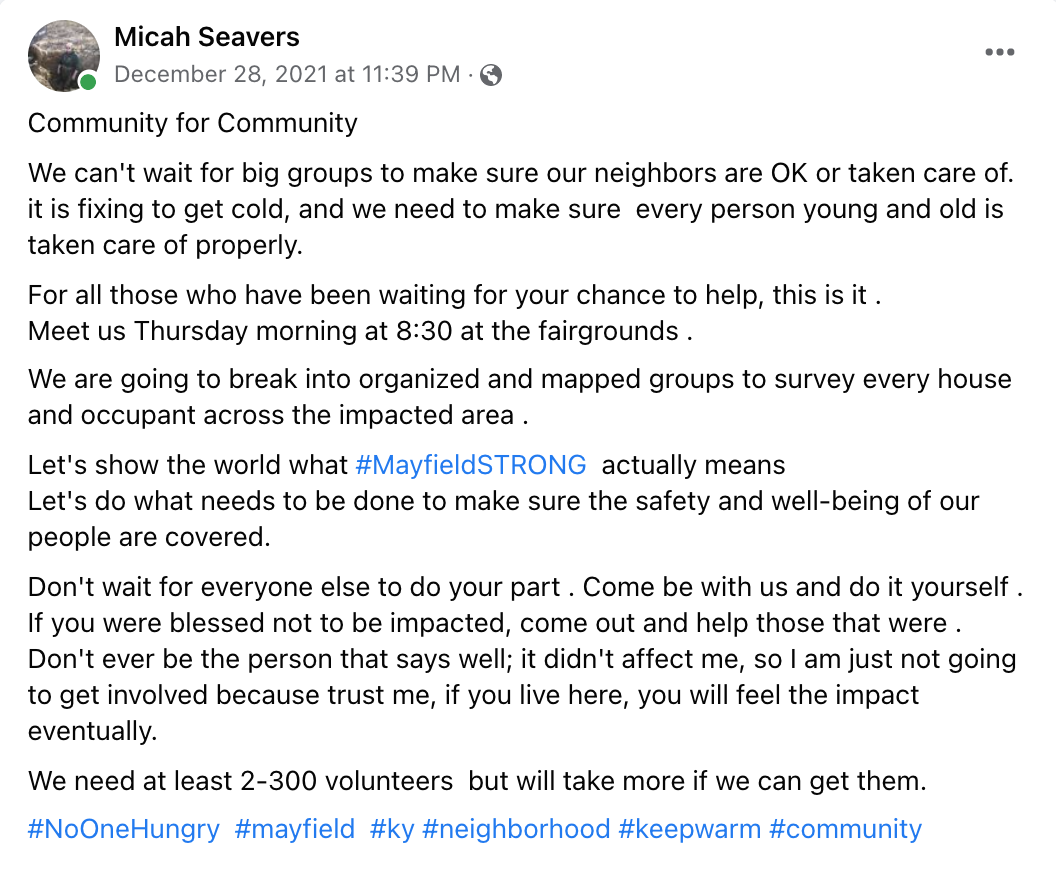
Micah issued an urgent plea on Facebook. It said:
No one should go uncared for.
Be the ripple that makes the wave. We can all make a difference.
He called his post: Community for Community.
December 30
As volunteers began getting ready for a day of visiting neighbors, Micah encouraged. He said on Facebook: We are all neighbors no matter what part of town you’re from or anything. Everyone deserves to be checked on.
Before the group reported out to their assigned streets, Micah prayed over their mission and asked God to help them find those who needed them the most.
January 1
The weather forecast started to call for snow, which Micah knew would be devastating for some in the community who were living in homes that had tarped roofs or holes.
“It comes down to basic human needs,” he said. “It was warm—we had good weather right after the tornado. It made the helping easy. But, we saw it coming, and we realized that people didn’t have natural gas and were so dependent on it. Their houses weren’t ready for electric heaters. A lot of these houses were older, and they weren’t wired up to have a lot of electric heaters going. Something had to be done. They’d been giving out heaters, but no one had assessed the problem and knew that this was going to cost $25-$30 per day per house. These people don’t have the money to do that.”
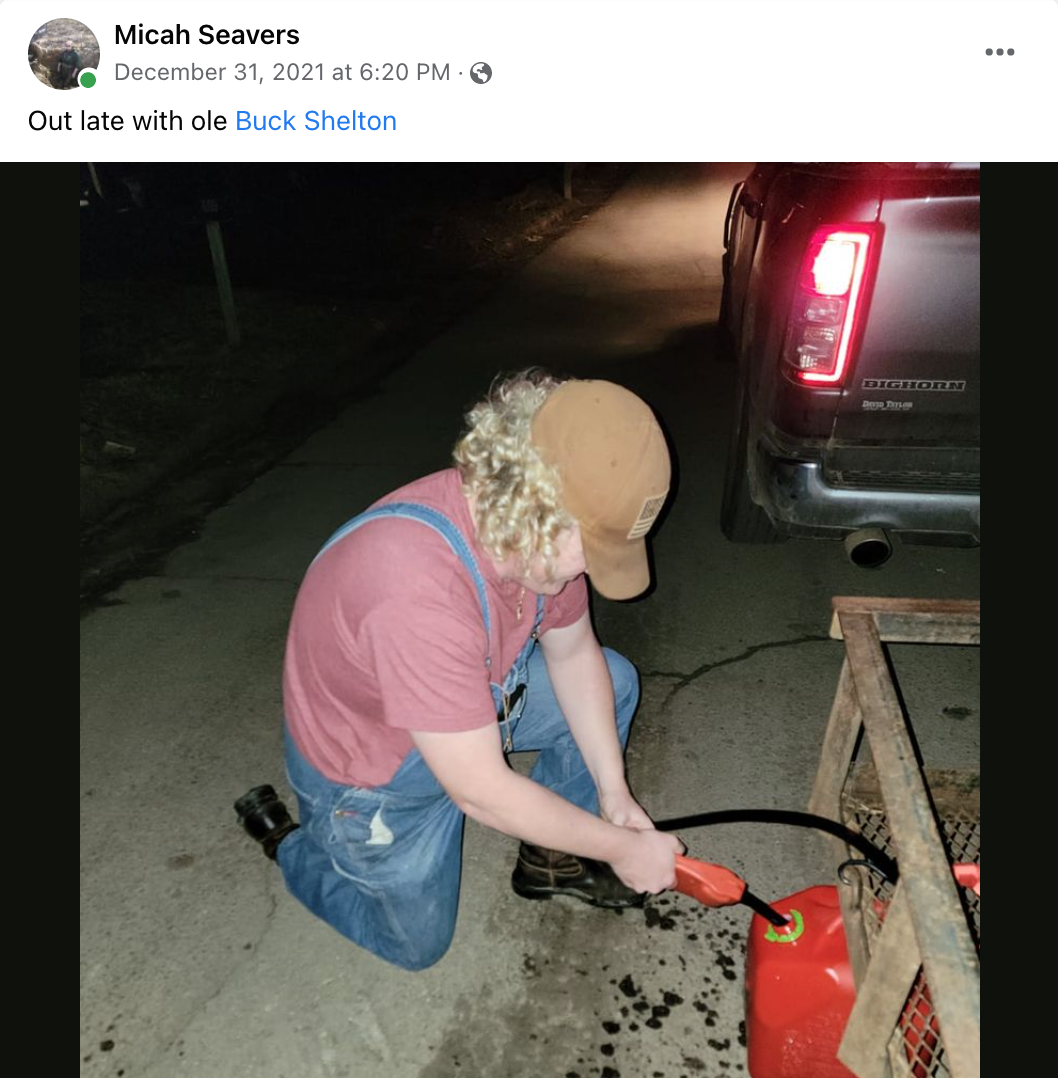
Micah was worried. Along with Buck, Micah started filling propane tanks and generators for people who had no heat.
They welcomed the local news station to follow them around as they worked.
January 2
It was Sunday, and Micah and Kim were filling their hearts and souls with worship, but as soon as it was over, he was going back out to fill heaters and generators to keep people warm. Belinda, Kim, and volunteers were going to deliver meals.
He was thankful for everyone that had made his hard work possible. He said on Facebook: This is a community effort, not a Southern Red’s BBQ or Micah Seavers effort. Without everyone coming together to help, this would not be close to possible.
January 7
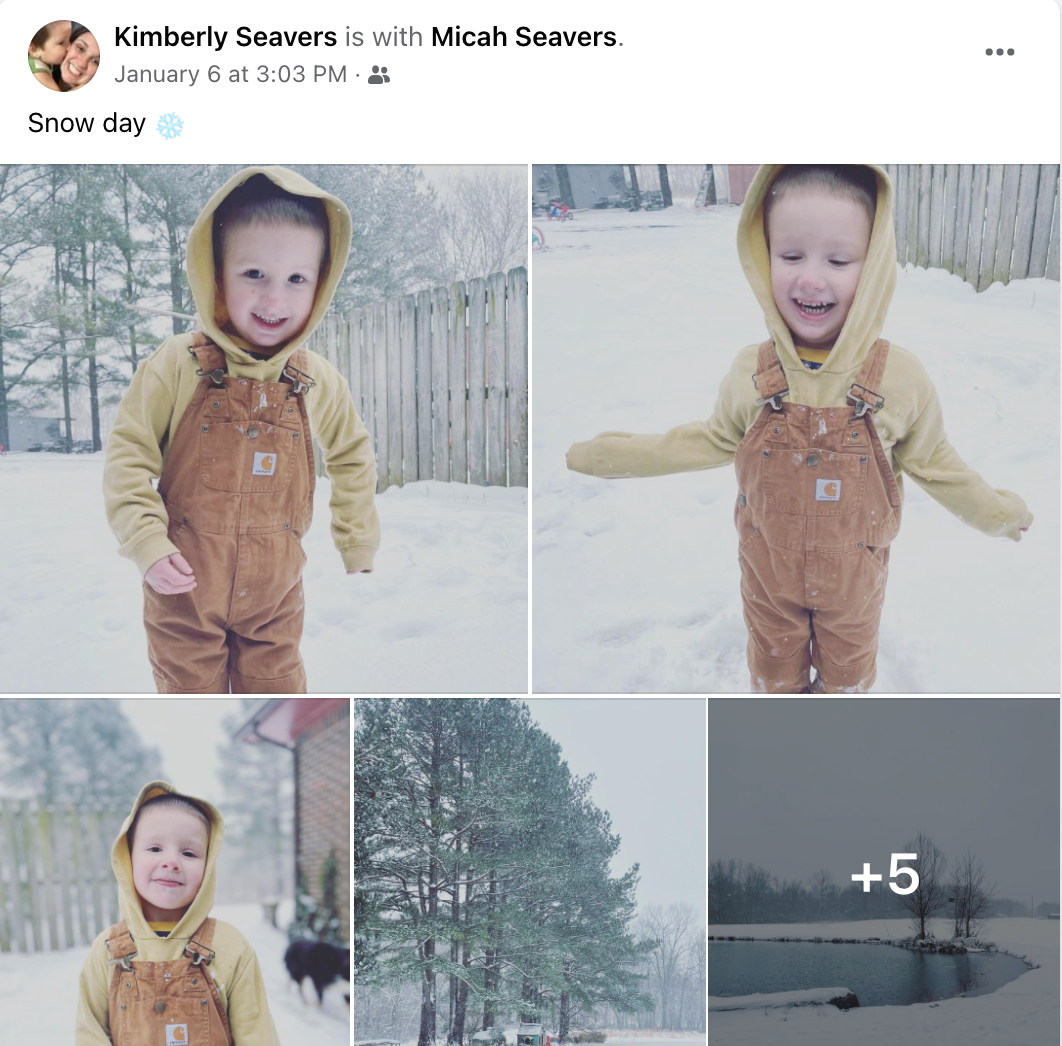
Kim posted photos on Facebook of their children in the snow. Micah braved the icy roads to continue responding to those who needed heat.
That day, Micah gave his shoes to a man he had never met before December 10 so that the man could be safe when he went outside. Kim got the picture of a barefoot Micah from a friend, laughed, and shared it on Facebook. It received 152 comments and 450 shares.
January 10
On the one-month anniversary of the tornado’s impact in Mayfield, Micah, Kim, and I talked about the month we’d all experienced.
In 30 days, the couple had fed 100,000 meals. They were still delivering hot meals—350 per day. They still had families taking shelter in their campground. Micah and several others were still making sure that everyone was warm.
They had learned some things, but they also had hardened their resolve to continue working for their hometown as it started to heal and rebuild.
“We have been blessed to have just a great community to start with,” Micah said. “Now we have a route down, and we are starting to work with other groups and divide the resources, so no one is getting burned out or exhausted. We have had everywhere from no volunteers to 25-30 at a time. Some days it’s just us, and some days it’s lots.”
“When we are out, the need is not always obvious,” he said. “Just because someone’s house looks okay doesn’t mean they have all their utilities or they feel mentally or physically capable of getting out. Some of these older folks have yet to leave their houses because they are too scared to get out.”
“At the end of the day, it hit the poorest portion of Mayfield,” he said. “Those people were struggling day-to-day anyway.”
The needs in the first month after the tornado were so great, but Micah said that one of the most pressing he found was surprisingly simple.
“The biggest thing I’ve seen is taking five minutes to talk to someone. Regular old conversation— just having people around,” he said.
“That’s the biggest need that I have seen besides heating and food.”
Micah said that as he was driving around, delivering meals, pouring fuel, shaking hands, patting backs, handing out jackets and dry socks that he was really bringing with him, something even greater.
“Just being there for folks,” he said. “Just letting people know that they have friends and neighbors that are there, no matter what side of the tracks they live on, no matter what they look like or how many tattoos they have on their face. It doesn’t make a difference. You’re there, and you’re happy to see them, and they are happy to see you.”
Micah said he was uncomfortable with the amount of exposure he got on Facebook, on the local news, and yes, even in VUE Magazine, for what he did in that first month.
“I feel kinda guilty that I get all these accolades and praise, and I seem to be out in front when there are so many people pushing from behind and standing beside of me and out there doing just as much as I am,” he said. “They may not be as noticeable.”
But Micah and Kim’s actions in that first month, combined with the actions of everyone around them to bring hope, love, food, heat, and comfort, are the legacy that they and this tragedy left for our community. It’s the way we shape the future.
Kim recalled that Micah even took their kids out with him and made them carry things.
“Our daughter, Charlee, is seven, and she said she just wanted to help dad help people,” Kim said.
For Micah, having his children with him was far greater than just having extra hands for heavy lifting.
“I think people need to realize that what they do now in front of their kids and in front of other people’s kids will help guide the example that they are leading,” he said. “This is something that people will not forget anytime soon. Your children will not forget who you were in this. Other people’s children will not forget who you were in this. I see houses where you can tell that these kids need to see that there are people in this world that care.”
“We want to be the example that we want our kids to become and that we’d like to see other people’s kids become,” he said.
“People will remember this.”